
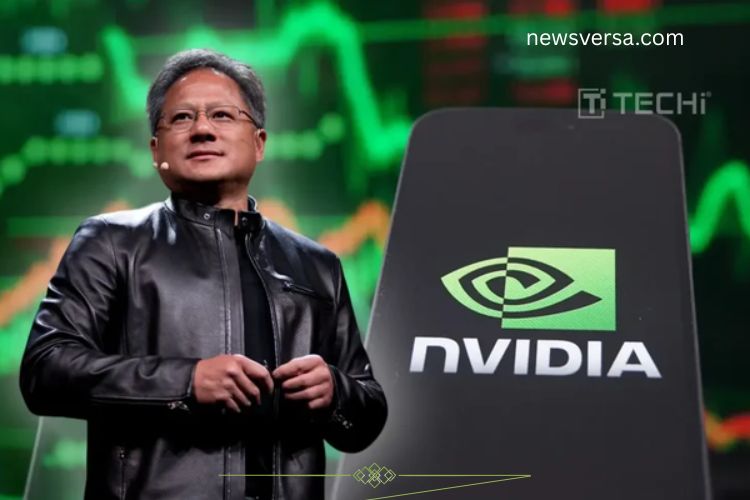
Nvidia’s meteoric rise has become one of the most compelling stories in the tech sector of the 2020s. With a market capitalization of $3.5 trillion and a stock price of $142.34 as of June 9, 2025, Nvidia has evolved far beyond a traditional chipmaker. Today, it serves as the backbone of the global AI revolution. After such a historic run, investors are asking: what’s next for Nvidia, and how could its stock perform over the next five years?
Read More: Crack Today’s Wordle #1701: Essential Clues and Winning Answer for Feb 14, 2026!
From Gaming Powerhouse to AI Leader
Nvidia’s journey from dominating gaming graphics to becoming the leading AI infrastructure provider has been extraordinary. Its data center business has grown at a staggering pace, reporting $44.1 billion in sales for the first quarter ending April 27, 2025—up 69% year-over-year and 12% from the previous quarter. These figures are particularly impressive given headwinds like U.S. export restrictions to China, yet Nvidia’s growth engine remains strong.
The key to Nvidia’s success? Its GPUs have become the global standard for training and deploying AI models. Major cloud providers—including Microsoft Azure, AWS, Google Cloud, and Oracle Cloud—have integrated Nvidia’s Blackwell GPUs, while specialized AI cloud services deploy clusters of over 100,000 chips. CEO Jensen Huang emphasized the company’s vision:
“AI is advancing at light speed as agentic AI and physical AI set the stage for the next wave to revolutionize the largest industries.”
Data Center Dominance: The Blackwell Effect
Nvidia’s data center segment is the crown jewel of its business. In the latest quarter, sales surged 73% year-over-year to $39.1 billion, representing 88% of total revenue. The launch of the Blackwell GPU series has been transformative, generating $11 billion in sales during its first quarter—the fastest ramp-up in Nvidia’s history. CFO Colette Kress called it “the fastest product ramp in our company’s history.”
Blackwell’s efficiency in AI inference workloads has fueled widespread adoption across cloud, enterprise, and on-premise environments. Microsoft, for example, has deployed tens of thousands of Blackwell GPUs and plans to expand further, thanks to its partnership with OpenAI.
Early-stage production costs and supply chain challenges have caused some margin pressure, but Nvidia expects recovery by late fiscal 2026. The upcoming Blackwell Ultra, set for the second half of fiscal 2026, promises further improvements in networking, memory, and processing capabilities.
Expanding Beyond AI: Gaming, Automotive, and Robotics
While AI and data centers drive Nvidia’s growth, other divisions are also thriving. The gaming segment, once the company’s flagship business, saw revenue climb 42% year-over-year to $3.8 billion, boosted by high demand for PC graphics cards and new gaming consoles.
The automotive and robotics segments are gaining traction as well. Automotive revenue surged 103% year-over-year to $570 million. Partnerships with Toyota and Hyundai, combined with Nvidia’s Cosmos robotics platform, are driving advancements in autonomous vehicles and industrial automation.
Global Challenges and Opportunities: The China Factor
U.S. export restrictions to China present one of the biggest uncertainties for Nvidia’s growth. In Q1 of fiscal 2026, the company faced a $4.5 billion charge due to unsold H20 processors after new licensing requirements restricted access to the Chinese AI chip market.
Despite these hurdles, Nvidia’s global footprint is expanding. The company is actively building AI infrastructure in countries including Japan, India, Korea, Spain, Italy, Germany, and the U.K. “Sovereign AI” projects are expected to become a major growth driver. Global investment in AI infrastructure is projected to reach $7 trillion by 2030, with nearly three-fourths directed toward data centers—a trend that plays directly to Nvidia’s strengths.
Financial Performance and Valuation Outlook
Nvidia consistently surpasses even the most optimistic forecasts. If earnings grow at an annual rate of just 20% after fiscal 2028, EPS could reach $9.50 in five years. With a conservative forward P/E multiple of 25—below its five-year average of 40—the stock could hit roughly $237, a 73% gain from current levels.
However, risks remain. Nvidia’s high valuation, with a current P/E around 46, has some analysts cautioning investors. Competition is intensifying, with AMD and Intel heavily investing to catch up. Regulatory hurdles, supply chain disruptions, and margin pressures from new product launches are also key considerations.
The Five-Year Outlook: High Reward, High Volatility
All indicators suggest Nvidia will remain central to the AI ecosystem. Global AI infrastructure spending is poised for explosive growth, sovereign AI projects are multiplying, and new product launches are on the horizon.
Nvidia’s dominance in data centers, expanding footprint in gaming and automotive, and relentless innovation make it a compelling long-term play. For investors, it represents a high-reward, high-volatility bet on the future of AI and advanced computing.
The next five years will test whether Nvidia can sustain its breakneck growth and fend off rising competition. History, however, suggests that betting against Nvidia has rarely been profitable. The AI titan’s journey is just beginning—and the world will be watching closely.
Frequently Asked Questions:
What makes Nvidia a leading AI powerhouse?
Nvidia has transformed from a gaming GPU company into the backbone of AI infrastructure. Its Blackwell GPUs dominate AI model training and deployment across major cloud providers and specialized AI platforms, making it a key player in the AI revolution.
How has Nvidia’s stock performed recently?
As of June 2025, Nvidia’s stock sits at $142.34, reflecting strong growth driven by its data center and AI businesses. The company has consistently reported double-digit quarterly revenue growth, even amid global supply chain challenges.
What role do Nvidia’s data centers play in its growth?
Data centers contribute the majority of Nvidia’s revenue, with sales up 73% year-over-year in the latest quarter. The launch of the Blackwell GPU series has accelerated adoption, cementing Nvidia’s position as a leader in AI infrastructure.
Is Nvidia still strong in gaming and other sectors?
Yes. The gaming division continues to grow, generating $3.8 billion last quarter, while automotive and robotics segments are expanding rapidly, driven by partnerships with companies like Toyota and Hyundai and innovations in autonomous driving.
How do global factors like China impact Nvidia?
Export restrictions to China have temporarily affected Nvidia’s sales, resulting in a $4.5 billion charge from unsold processors. However, the company is actively expanding AI infrastructure in other global markets, including Europe and Asia, which offsets some regional risks.
What are analysts projecting for Nvidia in the next five years?
Conservative estimates suggest Nvidia’s EPS could reach $9.50 by 2030. With reasonable valuation multiples, the stock could potentially climb to $237, representing significant upside. Growth will depend on AI adoption, new product launches, and market competition.
What risks should investors consider?
Key risks include high valuation, supply chain disruptions, regulatory hurdles, and intensifying competition from AMD, Intel, and emerging AI chipmakers. Margins may also fluctuate due to early-stage product costs and production scaling.
Conclusion
Nvidia’s rise from a gaming GPU company to the global AI powerhouse illustrates the company’s unmatched innovation and strategic vision. With its dominance in data centers, expanding influence in gaming and automotive, and pioneering AI technologies like the Blackwell GPU series, Nvidia is well-positioned to capitalize on the explosive growth of global AI infrastructure. While risks like high valuation, regulatory hurdles, and rising competition exist, the company’s track record of innovation and strategic execution makes it a compelling long-term investment. Over the next five years, Nvidia’s trajectory will likely continue to be shaped by AI adoption, new product launches, and global expansion—offering investors both high rewards and high volatility.