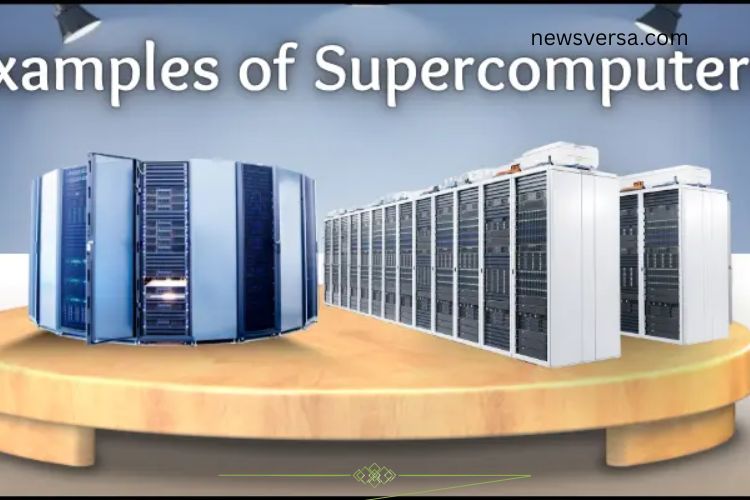
Did you know that today’s fastest supercomputers can perform billions of calculations every second? These technological marvels drive advancements in weather forecasting, space exploration, medical research, and artificial intelligence. Their incredible speed and power allow scientists and researchers to solve complex problems that were once unimaginable. In this article, we explore 10 examples of supercomputers that are shaping the future of science and technology.
Read More: Minicomputer: Unleashing the Power and Precision of Compact Computing
What Are Supercomputers?
Supercomputers are the most powerful computers in the world, designed to handle massive amounts of data and perform complex calculations at extraordinary speeds. Unlike standard computers, supercomputers are used for large-scale tasks like predicting the weather, analyzing space phenomena, conducting medical research, and running advanced simulations. Their ability to process millions—or even billions—of operations per second makes them indispensable for scientific progress.
Fugaku (Japan)
Fugaku, developed by RIKEN and Fujitsu in Japan, was once the world’s fastest supercomputer. It is a critical tool for research in COVID-19, weather forecasting, and artificial intelligence. Fugaku’s high-speed processors and extensive memory allow it to tackle enormous datasets efficiently.
Key Uses:
- Medical and health research
- COVID-19 studies
- Climate and weather prediction
- AI and machine learning projects
Key Features:
- Speed: 442 petaflops per second
- Memory: 7.6 petabytes
- Advanced Arm-based Fujitsu A64FX processors
- Energy-efficient operations
- Parallel computing for multitasking
Summit (USA)
Built by IBM and housed at the Oak Ridge National Laboratory in Tennessee, Summit started operating in 2018. It is designed to perform complex scientific calculations quickly, making it ideal for AI, machine learning, and data-intensive research.
Key Uses:
- Disease research and drug discovery
- Climate modeling
- Space and physics research
- AI-driven experiments
Key Features:
- Thousands of processors working in parallel
- Large storage and fast data transfer
- Energy-efficient design
- Advanced cooling systems for continuous operation
Sierra (USA)
Sierra, developed by IBM in 2018, supports the Lawrence Livermore National Laboratory. It is mainly used for nuclear research and large-scale scientific computations.
Key Uses:
- National security
- Energy and healthcare research
- Natural disaster prediction
Key Features:
- Speed: 125 petaflops
- Memory: 1.3 petabytes
- Energy-efficient design
- AI support for advanced modeling
Sunway TaihuLight (China)
Launched in 2016 by China’s National Research Center of Parallel Computer Engineering and Technology (NRCPC), Sunway TaihuLight was once the fastest supercomputer in the world. It excels in weather modeling, space research, and large-scale scientific calculations.
Key Uses:
- Climate and weather research
- Medical science simulations
- Clean energy projects
- Solving complex scientific problems
Key Features:
- Over 10 million processor cores
- Home-grown Chinese processors
- Low power consumption for its speed
- High-capacity memory
Tianhe-2A (China)
Developed by the National University of Defence Technology (NUDT), Tianhe-2A is one of China’s most powerful computing systems. It supports scientific research, national security, and medical advancements.
Key Uses:
- Weather prediction and storm analysis
- Physics and chemistry simulations
- Drug discovery and development
- Defense research and national security
- Big data analysis
Key Features:
- Speed: 33.86 quadrillion calculations per second
- Over 3 million processor cores
- Water-cooling system
- Parallel processing for simultaneous tasks
Perlmutter (USA)
Built in 2021 by Cray Inc., Perlmutter is one of the latest supercomputers in the United States. It combines speed, power, and energy efficiency to tackle demanding scientific problems.
Key Uses:
- Weather and climate research
- Medical and health studies
- Energy and environmental research
- Space and physics experiments
- AI and technology development
Key Features:
- Thousands of high-speed processors
- GPU-based acceleration
- Parallel computing
- High data storage capacity
- Energy-efficient operation
LUMI (Finland)
LUMI, built in 2020 by Hewlett Packard Enterprise (HPE), is Europe’s most powerful supercomputer. It delivers incredible performance while minimizing energy consumption.
Key Uses:
- Weather prediction
- Scientific research
- Medical and pharmaceutical development
- Energy studies
- Space exploration
Key Features:
- Multiple processors for rapid computation
- High-capacity memory
- 24/7 operation
- Support for multiple scientific programs simultaneously
Leonardo (Italy)
Launched in 2022, Leonardo is Italy’s state-of-the-art supercomputer. It combines high-speed computing with energy-efficient technology, making it ideal for scientific, industrial, and AI research.
Key Uses:
- Medical research for new treatments
- Aerospace and automotive design
- Energy optimization studies
- Space technology development
Key Features:
- Memory: 2.8 petabytes
- Speed: 250 quadrillion operations per second
- Intel Xeon Platinum and Sapphire Rapids processors
- High-speed data handling
Frontier (USA)
Frontier, constructed in 2022 with Cray Inc. and AMD, is the first supercomputer to cross 1 exaFLOP speed. It is used for research in health, energy, and space.
Key Features:
- Over 8.7 million cores
- High-speed memory
- Liquid cooling for temperature management
- Located at Oak Ridge National Laboratory
Param Siddhi-AI (India)
Param Siddhi-AI, launched in 2020 by C-DAC, is India’s most powerful supercomputer. It is optimized for AI, big data, and large-scale scientific projects.
Key Uses:
- Big data processing
- Climate modeling
- Robotics development
- Space research
Key Features:
- Billions of calculations per second
- Multi-processor parallel operation
- Energy-efficient design
- AI and machine learning support
Frequently Asked Questions:
What exactly is a supercomputer?
A supercomputer is an ultra-powerful computer designed to perform massive calculations at incredible speeds. Unlike regular computers, it can process billions or even quadrillions of operations per second, making it ideal for complex tasks like weather forecasting, AI, space research, and medical simulations.
Which supercomputer is currently the fastest in the world?
The Frontier supercomputer in the USA is the fastest, achieving over 1 exaFLOP, which means it can perform a billion billion calculations per second.
Which countries lead in supercomputing technology?
Countries like Japan, the USA, China, India, Italy, and Finland are leaders in developing supercomputers. These nations invest heavily in high-performance computing to advance science, healthcare, and technology.
Can supercomputers support artificial intelligence?
Yes! Most modern supercomputers, including Fugaku, Summit, and Param Siddhi-AI, are designed to run AI, machine learning, and deep learning applications, enabling faster and more accurate research outcomes.
Are supercomputers energy-efficient?
While supercomputers consume a lot of power due to their immense processing capabilities, modern designs like LUMI and Fugaku are optimized for energy efficiency, using smart cooling systems and low-power processors to reduce electricity usage.
How big is a supercomputer?
Supercomputers can be massive, often filling entire rooms or even buildings. They contain thousands or millions of processors and require specialized infrastructure to operate efficiently.
What is the difference between a supercomputer and a regular computer?
A regular computer is suitable for daily tasks like browsing, word processing, and media consumption. Supercomputers, however, are built for high-performance calculations, big data processing, and simultaneous multi-tasking at speeds millions of times faster.
Conclusion
Supercomputers are the powerhouses of modern science and technology, pushing the boundaries of what humans can achieve. From Fugaku in Japan to Frontier in the USA and Param Siddhi-AI in India, these machines are transforming fields like weather forecasting, medical research, AI, space exploration, and energy solutions. Their ability to perform billions—or even quadrillions—of calculations per second allows scientists and researchers to tackle problems that were once impossible.