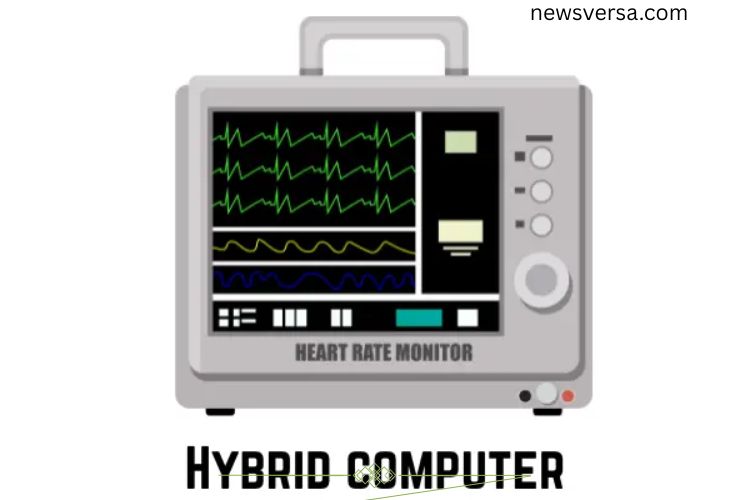
Did you know some computers can handle two tasks simultaneously? Hybrid computers are unique systems that combine the strengths of digital and analog computing. They can solve complex mathematical problems like digital computers while measuring real-world phenomena like analog systems. These versatile machines are widely used in hospitals, weather stations, factories, and scientific research. But what exactly is a hybrid computer, and how does it function? Let’s explore.
What is a Hybrid Computer?
A hybrid computer is a specialized device that merges digital and analog computing capabilities. It processes data rapidly like a digital computer while simultaneously measuring continuous, real-world values like an analog computer. This dual ability makes hybrid computers invaluable in environments where both speed and accuracy are essential.
For example, in hospitals, hybrid computers monitor heart activity in real time and store patient records efficiently. In meteorology, they collect continuous weather data while running complex predictive calculations. By combining the advantages of both computing types, hybrid computers deliver precise results quickly, making them indispensable in critical applications.
How Do Hybrid Computers Work?
Hybrid computers operate by splitting tasks between their analog and digital components. The analog part handles continuous, real-time data, while the digital component performs precise calculations. Here’s a simplified workflow:
- Data Collection (Analog) – Sensors gather real-time information such as temperature, pressure, or heart rate.
- Conversion to Digital – An Analog-to-Digital Converter (ADC) transforms this data into a digital format.
- Data Processing (Digital) – The digital system performs binary calculations and analyses.
- Result Integration – Analog and digital outputs merge to produce accurate results.
- Output – Processed information is displayed or used to control systems in real time.
This combination ensures tasks that require both immediate measurement and complex computation are handled seamlessly.
Types of Hybrid Computers
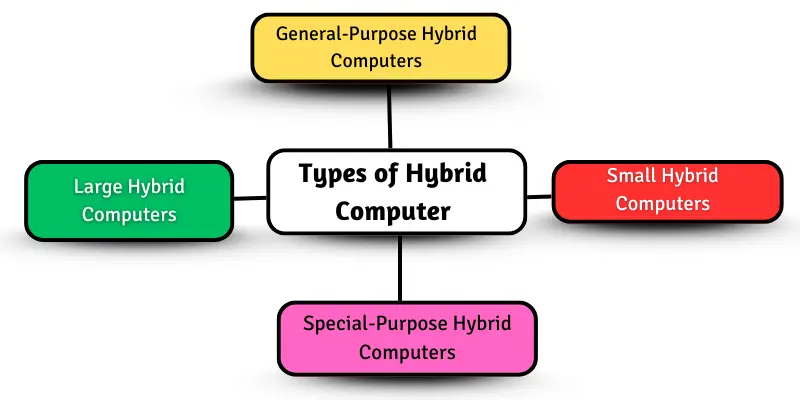
Hybrid computers vary depending on their purpose, size, and design. Each type blends digital and analog features to optimize performance for specific applications. The main categories include:
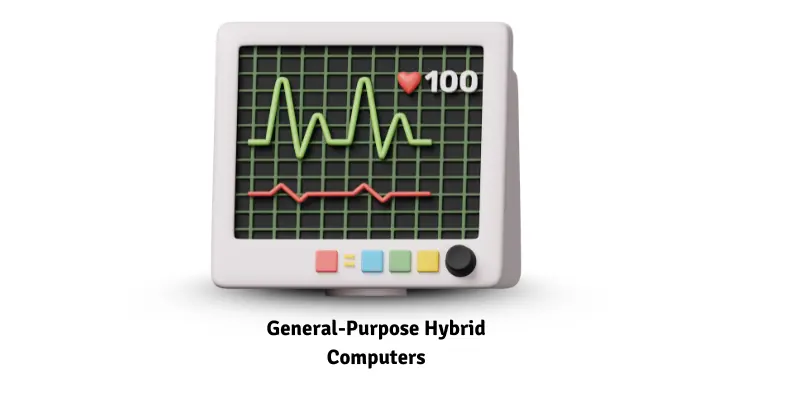
General-Purpose Hybrid Computers
General-purpose hybrids are versatile machines capable of handling multiple tasks. They excel in environments where both real-time monitoring and complex computations are needed.
Features:
- Flexible and adaptable to various tasks
- Simultaneously manages real-time data collection and digital calculations
- Commonly used in healthcare and scientific research
Examples:
- ECG Machines – Monitor heartbeats while storing patient data
- Scientific Instruments – Collect and process research data
Special-Purpose Hybrid Computers
Special-purpose hybrid computers are designed for specific tasks, combining analog and digital functions to optimize performance.
Features:
- Tailored for particular jobs
- Provides highly accurate, real-time results
- Ideal for simulation and control systems
Examples:
Flight Simulators – Provide real-time feedback for pilot training
Space Equipment – Analyze space data and assist spacecraft control
Large Hybrid Computers
Large hybrid computers handle extensive, complex tasks requiring massive data processing. They are ideal for industries and research fields that demand high-speed calculations combined with real-time measurement.
Features:
- Capable of processing enormous datasets
- Performs high-performance calculations in real time
Examples:
Weather Forecasting Systems – Analyze satellite data to generate accurate forecasts
Scientific Research Labs – Run large-scale simulations and experiments
Small Hybrid Computers
Small hybrid computers are compact but powerful. They are designed for portability while maintaining the ability to process both analog and digital data efficiently.
Features:
- Lightweight and portable
- Suitable for real-time monitoring and precise calculations
Examples:
- Portable ECG Monitors – Track heart rates outside of hospitals
- Robotics – Process sensor data to control robot actions in real time
Uses of Hybrid Computers
Hybrid computers are versatile and used across multiple industries where both accuracy and speed are critical. Their ability to merge real-time data collection with rapid calculations makes them ideal for complex tasks.
Key Applications:
- Medical Field – Monitor vital signs in real time and maintain patient records efficiently
- Weather Forecasting – Process continuous data from sensors and historical records for accurate predictions
- Industrial Automation – Control machinery and monitor production lines using real-time and calculated data
- Scientific Research – Conduct experiments requiring precise calculations and continuous measurement
- Space Exploration – Analyze space data and manage spacecraft systems
- Robotics – Control robot movements based on real-time sensor feedback
Advantages of Hybrid Computers
Hybrid computers offer numerous benefits by combining the strengths of analog and digital computing:
- High speed and accurate processing
- Ability to handle real-time and complex tasks simultaneously
- Reduced errors due to combined analog and digital functions
- Efficient multitasking saves time and improves productivity
- Enhances decision-making with precise results
- Suitable for critical fields like healthcare, scientific research, and space exploration
- Reliable performance under demanding conditions
Disadvantages of Hybrid Computers
Despite their advantages, hybrid computers also have some limitations:
- High cost compared to standard computers
- Complex setup and operation
- Requires skilled operators
- Large and sometimes bulky
- Not necessary for simple or routine tasks
- Maintenance can be expensive
- Higher power consumption
- Upgrades may be challenging
- Less energy-efficient for basic operations
Frequently Asked Questions:
What is a hybrid computer?
A hybrid computer is a type of computer that combines digital and analog features. It can perform precise calculations like a digital computer while simultaneously measuring real-world, continuous data like an analog system.
How does a hybrid computer work?
Hybrid computers collect real-time data through analog sensors, convert it into digital form using an Analog-to-Digital Converter (ADC), process it digitally, and then combine the results to produce accurate outputs.
Can hybrid computers be portable?
Yes, small hybrid computers are designed for portability and can be used in medical equipment, robots, or other compact devices.
How do hybrid computers differ from digital and analog computers?
Unlike purely digital computers, hybrid computers can measure real-world continuous signals. Unlike analog computers, they also perform precise calculations digitally. This combination makes them faster and more accurate for specialized tasks.
Are hybrid computers energy-efficient?
While they are powerful and versatile, some hybrid computers, especially larger models, may consume more energy due to their complex analog and digital systems.
Why are hybrid computers important?
They bridge the gap between real-world measurement and digital computation, making them critical in fields where accuracy, speed, and real-time processing are essential, such as healthcare, scientific research, and industrial automation.
Conclusion
Hybrid computers are a remarkable fusion of analog and digital technology, offering the best of both worlds—speed, accuracy, and real-time data processing. By combining the ability to perform complex calculations with the capacity to measure real-world phenomena, these computers have become indispensable in critical fields such as healthcare, scientific research, weather forecasting, robotics, and space exploration. Whether it’s monitoring a patient’s heartbeat, predicting severe weather, or controlling sophisticated machinery, hybrid computers deliver reliable, precise, and efficient performance.