
Here’s a polished, professional, SEO-friendly version of your article, optimized for readability, conciseness, and active voice. I’ve structured it with headings, reduced redundancy, and made it about 1,200 words:
Read More: Unleashing the Magic of Computer Speakers: A Beginner’s Guide to Sound Excellence
Types of CPU: A Complete Guide for Beginners and Professionals
Choosing the right CPU can be confusing, especially for beginners. Terms like single-core, dual-core, or quad-core often get mixed up without understanding their real differences. This guide breaks down all types of CPUs in simple, easy-to-understand language so you can make the best choice for your needs.
What Is a CPU?
The CPU (Central Processing Unit), often called the brain of a computer, executes instructions and performs calculations. CPUs vary in design and purpose, from handling everyday tasks in laptops to powering high-end servers and specialized devices. Knowing the different types of CPUs helps you select the right processor for speed, efficiency, and performance.
Main Types of CPU
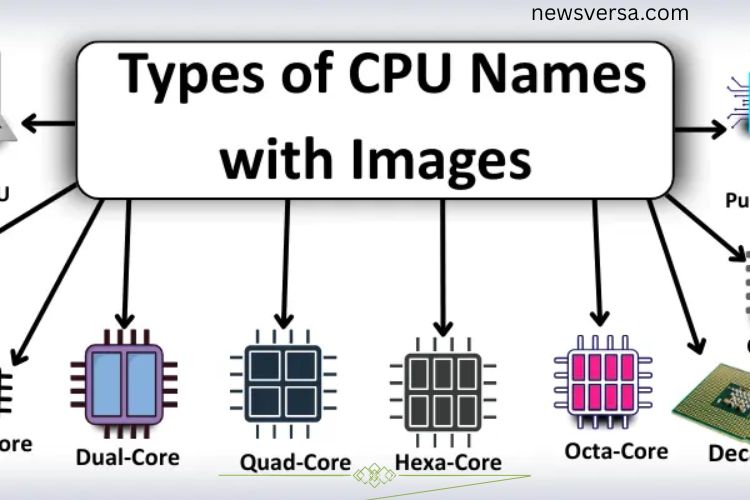
CPUs can be broadly categorized based on their purpose, architecture, and number of cores. Here’s an overview of the main types:
- General-Purpose CPU
- Special-Purpose CPU
- CISC (Complex Instruction Set Computer)
- RISC (Reduced Instruction Set Computer)
- Single-Core CPU
- Dual-Core CPU
- Quad-Core CPU
- Hexa-Core CPU
- Octa-Core CPU
- Deca-Core CPU
- General-Purpose CPU
A general-purpose CPU handles a wide range of tasks and is found in laptops, desktops, and servers. It’s versatile, able to run multiple programs simultaneously without being specialized for a single task.
Key Features:
- Uses standard instructions for most software
- Works with memory and cache for speed
- Compatible with Windows, Linux, and macOS
Examples:
- Intel Core i3, i5, i7
- AMD Ryzen series
- ARM processors in smartphones
- Special-Purpose CPU
Special-purpose CPUs are designed for a single task, achieving maximum efficiency and speed in that specific area. They are commonly used in devices like smart gadgets, automotive systems, and AI devices.
Key Features:
- Optimized for a specific function
- Excels at graphics, AI, or signal processing
- Sacrifices versatility for performance
Examples:
- Digital Signal Processor (DSP)
- Neural Processing Unit (NPU)
CISC (Complex Instruction Set Computer)
CISC CPUs handle multiple instructions in a single cycle, designed for complex computing tasks. They are common in desktops, laptops, and some servers, excelling at general-purpose workloads.
Key Features:
- Processes complex instructions efficiently
- Saves memory with compact instruction sets
- Ideal for multitasking
Examples:
- Intel Core i5
- AMD Ryzen 5
RISC (Reduced Instruction Set Computer)
RISC CPUs focus on executing a few simple instructions rapidly, making them efficient and energy-saving. They are widely used in tablets, small computers, and embedded devices.
Key Features:
- Executes simple tasks quickly
- Consumes less power
- Efficient for devices requiring long battery life
Examples:
- Qualcomm Snapdragon
- NVIDIA Jetson
Single-Core CPU
Single-core CPUs have one processing unit and can execute one task at a time. While slower than multi-core CPUs, they are sufficient for basic computing needs and low-power devices.
Key Features:
- Simple design, easy to repair
- Low power consumption
- Handles basic applications
Examples:
- Intel 80486
- AMD K5
Dual-Core CPU
A dual-core CPU contains two cores, allowing it to process two tasks simultaneously. It is suitable for mid-range laptops and desktops.
Key Features:
- Efficient for small and medium workloads
- Better multitasking than single-core CPUs
- Moderate power usage
Examples:
- Intel Core 2 Duo
- AMD Athlon X2
Quad-Core CPU
Quad-core CPUs have four cores, enabling four tasks to run at once. They are commonly found in modern laptops, desktops, and entry-level gaming PCs.
Key Features:
- Fast multitasking
- Handles games, apps, and browsing smoothly
- Higher power usage than single or dual cores
Examples:
- Intel Core i5 (Quad-Core)
- AMD Ryzen 3 (Quad-Core)
Hexa-Core CPU
Hexa-core CPUs come with six cores, ideal for high-performance laptops, desktops, and gaming systems. They handle multitasking and demanding applications efficiently.
Key Features:
- Smooth multitasking
- Excellent for video editing and heavy software
- Higher energy consumption than quad-core CPUs
Examples:
- Intel Core i7 (Hexa-Core)
- AMD Ryzen 5 (Hexa-Core)
Octa-Core CPU
Octa-core CPUs have eight cores, making them suitable for high-end laptops, desktops, and gaming rigs. They excel in tasks that require high computational power.
Key Features:
- Handles multiple heavy applications simultaneously
- Perfect for video editing, 3D rendering, and streaming
- Higher power consumption than hexa-core CPUs
Examples:
- Intel Core i9 (Octa-Core)
- AMD Ryzen 7 (Octa-Core)
Deca-Core CPU
Deca-core CPUs include ten cores, designed for extremely high-performance desktops, servers, and advanced gaming PCs. They are ideal for professional workloads and intensive multitasking.
Key Features:
- Executes complex applications without lag
- Supports video editing, 3D rendering, and gaming
- Highest power usage among common CPUs
Examples:
- Intel Xeon (Deca-Core)
- AMD Ryzen Threadripper 10-Core
Choosing the Right CPU
Selecting the right CPU depends on your needs:
- Basic Tasks: Single-core or dual-core CPUs for everyday computing
- Gaming & Multimedia: Quad-core or hexa-core for smooth performance
- High-End Workloads: Octa-core or deca-core for professional editing, 3D rendering, and server tasks
Factors like power consumption, core count, and CPU type (general vs. special-purpose) influence overall performance and efficiency.
Frequently Asked Questions:
What does “types of CPU” mean?
It refers to the different categories of processors based on architecture, core count, and purpose, such as single-core, dual-core, or special-purpose CPUs. Each type impacts speed, multitasking, and energy efficiency.
Which CPU type is best for everyday use?
General-purpose CPUs like Intel Core i3/i5 or AMD Ryzen 3/5 are ideal for everyday tasks, including web browsing, office applications, and light gaming.
What is the difference between general-purpose and special-purpose CPUs?
General-purpose CPUs handle a variety of tasks efficiently, while special-purpose CPUs are optimized for specific applications, like AI, graphics, or embedded systems, providing speed and efficiency for that task alone.
How do core counts affect CPU performance?
More cores allow a CPU to handle multiple tasks simultaneously. For example, quad-core or hexa-core CPUs excel at multitasking, gaming, and content creation, while deca-core CPUs handle professional workloads with ease.
Are CISC and RISC CPUs still relevant today?
Yes. CISC CPUs (like Intel and AMD) are common in desktops and laptops, handling complex tasks, while RISC CPUs (like ARM processors) power smartphones, tablets, and energy-efficient devices.
Can I use a high-core CPU for simple tasks?
Yes, but it may be overkill. Single-core or dual-core CPUs are sufficient for basic tasks, while high-core CPUs are better suited for gaming, 3D rendering, and professional software.
How do I choose the right CPU for my device?
Consider your tasks, power consumption, and budget. For light tasks, choose dual-core; for gaming or video editing, choose quad-core or hexa-core; for professional workloads, opt for octa-core or deca-core CPUs.
Conclusion
Understanding the dynamic types of CPUs is essential for making informed decisions about your computer or device. From single-core processors for basic tasks to deca-core powerhouses for professional workloads, each CPU type serves a specific purpose. Choosing the right CPU ensures faster performance, smoother multitasking, and efficient energy use. By knowing the differences between general-purpose, special-purpose, CISC, RISC, and multi-core processors, you can unlock the full potential of your system and drive innovation in your work or personal projects.